Showing posts with label history. Show all posts

Thursday, July 24, 2014

FC Bayern Munich: Too Jewish for the Nazis

Konrad Heitkamp was taken aback by the extraordinary ordinariness present in the lobby of the Zurich hotel. In November of 1943, life in Zurich seemed unperturbed by the fact that the countries surrounding Switzerland were embroiled in one of the most devastating wars in the history of the world. Heitkamp realized that as the coach of the FC Bayern München soccer team, he was one of the privileged few who could bask in this oasis of normalcy for a few days before he would have to head back home to Munich. He surveyed the lobby and began waving his hand at some of his players standing across the vestibule. Hopefully, the Gestapo men watching him thought of this as an innocuous gesture, a soccer team coach acknowledging the arrival of his players and performing a headcount. But he could not bank on it.


The Gestapo must have known that for the past weeks, Heitkamp and his players were forward to the friendly match against the Swiss national soccer team because it would give them a chance to finally see their friend Kurt Landauer again. Before the team embarked on their trip to Zurich, the Gestapo had ordered all Bayern München players to attend a special "education" session in Gestapo headquarters of Munich. The team was informed that the Gestapo would accompany the team on their brief trip to Switzerland. The Gestapo explicitly forbade the team members to have any contact with German emigrants in Switzerland.

The Nazis were always weary of any potential contacts between Germans and German emigrants who were seen as traitors and collaborators of the Allied forces. But FC Bayern München was a special thorn in the flesh of the Nazi machinery. Nazis routinely referred to FC Bayern München as a "Judenclub" ("Jew Club"), because German Jews had held some of the key leadership positions. The club won its first German national soccer championship in 1932 under the leadership of the Jewish club president Kurt Landauer and the coach Richard Dombi, an Austrian Jew. Only a few months later in January 1933, Hitler came to power and soon all leaders of Jewish origin were forced to give up their leadership positions.

Kurt Landauer was one of the first to resign from the club presidency. He even lost his job as the manager of a Munich newspaper's advertising department, and was only able to find work in a textile shop owned by a Jewish family. In the wake of the anti-semitic pogroms in the night of the 9th November 1938 (Kristallnacht oder Reichspogromnacht), this shop was attacked and devastated. Landauer was arrested and sent to the Dachau concentration camp. After a brief period of internment, he was released and he used this opportunity to emigrate to Switzerland and survived the Holocaust. Most of his siblings were less fortunate and were murdered by the Nazis.


Konrad Heitkamp and his wife Magdalena are about to walk towards their hotel room, when a bellhop appears in front of them and hands Heitkamp a note. It is a message from Kurt Landauer. Heitkamp tries to suppress his excitement , but it is already too late. Before he can even read the note, a man taps him on the shoulder and says "Gestapo. Give me the note. We know who it is from and we absolutely forbid you to have any contact with that man. We are watching you!"

For the remainder of the trip, the Gestapo closely walls off Heitkamp and his players, making it impossible for them to have any contact with Landauer. But the players still manage to embarrass the Nazis and the Gestapo. Immediately after the whistle is blown to start the game, the FC Bayern München players run up to the area of the soccer field in front of Kurt Landauer and greet their former president from afar.

The book "Der FC Bayern und seine Juden: Aufstieg und Zerschlagung einer liberalen Fußballkultur" (FC Bayern and its Jews: The Rise and Destruction of a Liberal Soccer Culture) by the German soccer historian Dietrich Schulze-Marmeling describes the prevalent culture of tolerance at FC Bayern München in the years prior to the Nazi takeover of Germany. Many members, players and leaders of the club were Jewish, but the question of ethnicity or religion was not even a real issue for the club. All that really mattered was whether or not you were a member of the club. Once the Nazis came to power in 1933, they tried to install their henchmen at leadership positions of all institutions, including sport clubs. TSV 1860, the other big Munich soccer club, immediately acquiesced to the new Nazi masters, allowing  SA men to take control of the club from 1934 onwards. Players and members of FC Bayern München, on the other hand, staving off Nazi leadership up until 1943. The Nazis were often frustrated by the recalcitrant "Judenclub" which resisted and delayed the implementation of Nazi ordinances.

I have been an FC Bayern München fan all my life. My childhood home in Munich was just a ten minute walk away from the club's headquarters at the Säbener Strasse. It is not difficult to be proud of its achievements. In 2013, the club won every major trophy that it was eligible for - Bundesliga champions, the German soccer federation cup (DFB-Pokal), the European Champions League and the 2013 FIFA Club World Cup – thus underscoring its dominance as the world's best soccer club. But none of these victories made me as proud of my club as finding out about how my club defied anti-semitism and the Nazis.

Image: The headquarters of FC Bayern München in the Säbener Strasse (photo by J. Rehman)


Note: An earlier version of this article was first published on 3Quarksdaily.com.

Reference: Schulze-Marmeling, D. (2011). "Der FC Bayern und seine Juden: Aufstieg und Zerschlagung einer liberalen Fußballkultur". Werkstatt GmbH

Thursday, September 27, 2012

Libricide in the Digital Age

Plaque in Frankfurt, reminding us of the Nazi book-burning
Via Wikimedia - ArcCan 
My bookshelves are bulging and I am just running out of space for books. I enjoy buying books, but I have a very hard time when it comes to getting rid of them. After I have finished reading a good book, I become attached not just to the physical book, but also to the ideas and memories associated with that book. When I look at the book, I remember the fun I had reading it and I also think about how it made me feel and how it inspired me to think or write.

As an old-fashioned and traditional bookophile, I was a bit reticent when it came to trying it out E-books. I was worried that I would miss the tactile pleasure of thumbing through the physical pages. I was concerned that the digital highlighting on a Kindle reader would be no match for the visual pleasure elicited by the fluorescent glow of my German Stabilo highlighters. I also did not like the fact that I would have to pay the full price for every E-book, because one could not walk into a used ebook store and get bargain books for a few cents.

Nevertheless, I gave it a try. Once I started using the Kindle App on the iPad, I realized that the ability to carry thousands of books around with me, gave me a completely new kind of bookophile pleasure. I missed my Stabilo highlighter and the ability to physically grasp books, but the fact that Rilke, Orwell and Zadie Smith were all tucked away in my backpack, gave me a completely new kind of bookophile pleasure. I was about to extol the pleasures of ebooks to everyone and was thinking about gradually becoming an ebook-only kind of person.

Then I read two articles. The first one was "Will Your Children Inherit Your E-Books?" by Amanda Katz and asked the simple question of how does one inherit E-books?


In the age of the e-book, the paper book faces two possible and antithetical fates. It may become something to be discarded, as with the books that libraries scan and cannibalize. (In the introduction to another book, Unpacking My Library: Writers and Their Books, Price mentions the severed book spines that hang on the wall at Google, "like taxidermists' trophies.") Alternatively, it may become a special object to be preserved and traded. My grandfather's copy of War of the Worlds obviously falls into the second category — but very few of the millions of books published since the mid-19th century are ones you'd want to own. If Amazon has a "long tail" of obscure but occasionally purchased titles, the tail that goes back 150 years is near endless and thin as thread.
 Meanwhile, the kind of "serial" book sharing (as Price describes it) that occurs over time is giving way to simultaneous, "synchronous" sharing. With the Kindle, you can see what thousands of other Kindle readers are highlighting in the book you're reading — a fairly astonishing innovation. But the passage of books from hand to hand, gathering inscriptions along the way, is not part of the e-book economy. Will your grandchild inherit your Kindle books? No one knows, but given password protection and the speed at which data becomes obsolete, that seems highly unlikely.
Read more here...

I was stumped by this article. Of course I want my children and grandchildren to inherit my books. I still treasure a small century-old dictionary that my grandfather gave me, and I hope that my grandchildren will also enjoy thumbing through my old books. But how will they do this, if all I leave them are a bunch of files, many which may or may not be password-protected. Will I remember to tell them my Kindle password before I die? Does a dying bookophile gather around their family and tell them "My Kindle password is Lolita underscore Camus" before he passes on? Or will my E-books die with me?

The second article "How to Make a Book Disappear" was written by Maria Konnikova and discussed the ironic disappearance of George Orwell's 1984 from some Kindle devices because the retailer Amazon had detected that certain versions of these E-books were violating the copyright. Konnikova also brought up the excellent point that making digital books vanish could be the future version of book-burning:
An e-book is not a physical book. That point might seem trite until you stop for a moment to think how much simpler it is, in a certain sense, to destroy electronic than physical traces. There's no need of inciting mass cooperation in book-burning enterprises. No need for secret police or raids or extensive surveillance. The power to remove a book from a device, to remove all traces of it from retailers' websites, to expunge it from a publisher's online record: It would simplify the work of a would-be Soviet Union or Oceania multifold, would it not? It's ugly. For all kinds of reasons.     
Read more here...

After reading these articles, I am now rethinking my conversion-in-progress towards ebookophilia. I still like the physical feel of books and do not like the idea of my books dying or disappearing. I cannot afford to buy both, the hardcopy and E-book version of each book, so I am probably going to stick to buying old-fashioned books for now.

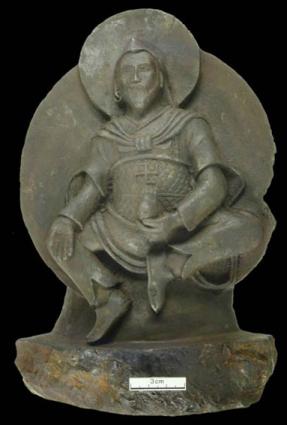
Buddhist ‘Iron Man’ found by Nazis is from space

Buddhist Iron Man via Elmar Buchner (Nature News Blog) 
I just love the headline of this article on the Nature blog. It sounds like the plot of a Sci-Fi-New-Age-World-War-II-Superhero Thriller.


A Buddhist statue brought to Germany from Tibet by a Nazi-backed expedition has been confirmed as having an extraterrestrial origin.
 Known as the ‘iron man’, the 24-cm high sculpture may represent the god Vaiśravaṇa and was likely created from a piece of the Chinga meteorite that was strewn across the border region between Russia and Mongolia between 10,000 and 20,000 years ago, according to Elmar Buchner of the University of Stuttgart, and his colleagues.
Read more here.....